Nearwell is our own product. It is a relationship manager for entrepreneurs, freelancers and consultants: it remembers who you know, what you discussed, what you promised and when to reconnect. We wrote its brief, built it and run it ourselves. There is no client in this story: what follows is what we decided, why, and where it stands.
The problem
You meet five interesting people at a conference: a possible customer, a developer, an investor, a founder, someone who might become a partner. You swap details and have good conversations. Two months later you cannot remember what you talked about, where they worked, or whether you promised to get back to them.
What you knew lives in a phone’s contacts, LinkedIn, an inbox, a calendar and loose notes, or nowhere. Sales CRMs could hold it, but they are built around companies and pipelines, and they ask for minutes of form filling after every conversation. The people Nearwell is for keep a network of a few hundred and drop any tool that costs them that.
What we built
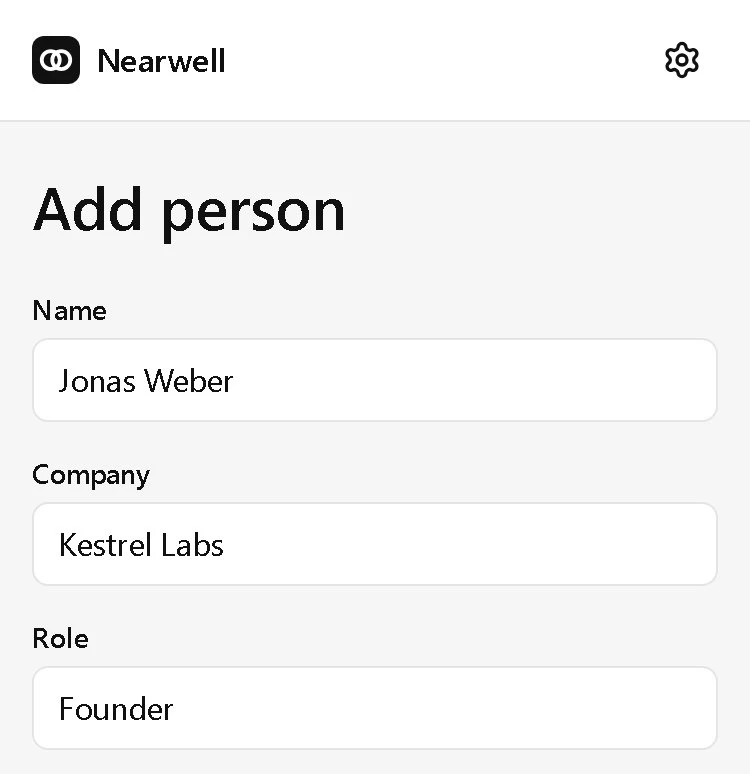
A web app, on a desk or a phone, in English and Dutch from the first screen. Each person keeps their details, where you met, your notes and every conversation you logged. Home answers one question: what needs me today? Meetings coming up, tasks that are due, and the people you meant to speak to again, with what you discussed last time.

Around that: tasks linked to a person, an activity page across everyone, companies, categories and tags, search across all of it, and import and export in the formats phones and Google already use. An optional list of opportunities is there for those who sell, and off for everyone else.
Principles that kept it small
The brief offered eight modules. We wrote four principles first and let them decide what made the first version.
- Relationship first. A person is never a lead by default. No money or stage is asked for unless the user turns opportunities on.
- Few steps. Logging a conversation is one short note. The date, the type and a follow-up all have sensible defaults.
- The user decides. Nothing is created, merged or sent on their behalf without them saying so.
- Their data is theirs to take. Everything can be exported, and an account can be deleted with its data.
Done means something you can check
Every feature in the specification carries a line saying when it is done: what someone can do or see when it works, and the failures that matter. That line is checked before the feature is marked built, and the result is written beside it, including what was not tested.
Search, for one, was done when a word from a note finds its contact, an empty result says so, and results come back in under half a second for 2,000 people. We filled an account with 2,001 people and 10,001 conversations: results came back in 170 to 250 milliseconds on a production build. The words you search for travel in a cookie, not in the address, so they stay out of the server’s logs.
Export was done when an export imports into a fresh account with nothing lost. A CSV export, imported into an empty account and exported again, came back byte for byte the same.
No AI, no score
A relationship manager is an easy place to add a score. Nearwell does not. How strong a relationship is (new, developing, active, strong or dormant) is the user’s to set, and the app never computes it.
Duplicates are found without AI: people who share an email address or phone number, or have nearly the same name at the same company. They are offered as possible duplicates and nothing merges without the user. A merge keeps every note, conversation and task of both, and a pair can be marked as two different people so it is never offered again.
Reminders that say little
Reminders reach the user outside the app as a daily email, off until they turn it on. It only arrives when something is due, its subject is a count and nothing more, and its body names people and tasks but never the notes about them. The unsubscribe link works without signing in.
Say less in the places you don’t control
An email passes through servers and lock screens we will never see. Nearwell’s digest says just enough to bring someone back to the app, where the details are.
What made it fast
The repository was created on 9 November 2026. On 11 November Nearwell was live at crm.silentpixel.net, every line of its first version built, with its privacy statement, terms and processing agreement published in both languages and accepted at sign-up.
Three days was possible because almost nothing had to be decided for the first time. Nearwell started from our own project template, with its checks already in place. Its hosting copies Marnu’s: the app and its database in Frankfurt, only the release branch builds, and nothing goes live until a person promotes it. Its board is held to the same shape by the same check. Its legal texts follow the ones we had already written for our other products. The time went into the product, because the foundations were already settled.
Some things still took care. The name was chosen on day one and checked in the EU and Benelux trademark registers and the Dutch business register on the day it went live. It lives in one file, and a check fails the build if it is written anywhere else, so renaming the product is a one-line change.
How it runs
- Every account sees only its own records, enforced by the database’s row-level security.
- The owners see twelve totals about accounts and settings, such as how many accounts exist, and never a user’s records.
- Feedback sent from the app is mailed to us with the sender as reply-to, and stored nowhere.
- Nothing reaches production until a person promotes it, and only after every check has passed on that exact commit.
Where it stands
Nearwell is live at crm.silentpixel.net and free for now, in English and Dutch.
What we take from it
A small product built in three days is only possible when it stays small and when the hard decisions were made before. The principles kept Nearwell small: no score, no AI, no step the user did not ask for. The foundations we had built for our other products made it fast.
That is the care we bring to software we build for anyone else.