Marnu is our own product, and we are its first customer. It keeps the books of SilentPixel V.O.F., the company that built it, and has done since the day after its first line of code. There is no client in this story: what follows is what we decided, why, and where the product stands.
The problem
A small business owner wants four answers: what came in, what went out, what they owe the tax office, and what is really theirs to spend. Most accounting software answers in the language of accountants. The owner gets a trial balance when they wanted to know whether they can afford a new laptop.
Software that speaks plainly has the opposite problem. It is easy to make a friendly screen with a number on it. It is hard to make that number right, and to keep it right when a bank line is matched twice, a payment is undone in a month already filed, or an invoice is corrected after the VAT return went in.
We wanted both: plain language on top, and books underneath that an accountant would sign off.
What we built
Marnu brings a small business’s administration into one place: quotes and invoices, expenses and receipts, bank imports matched to what each payment was for, Dutch VAT, customers, agreements and assets. It runs in the browser, on a desk or a phone.

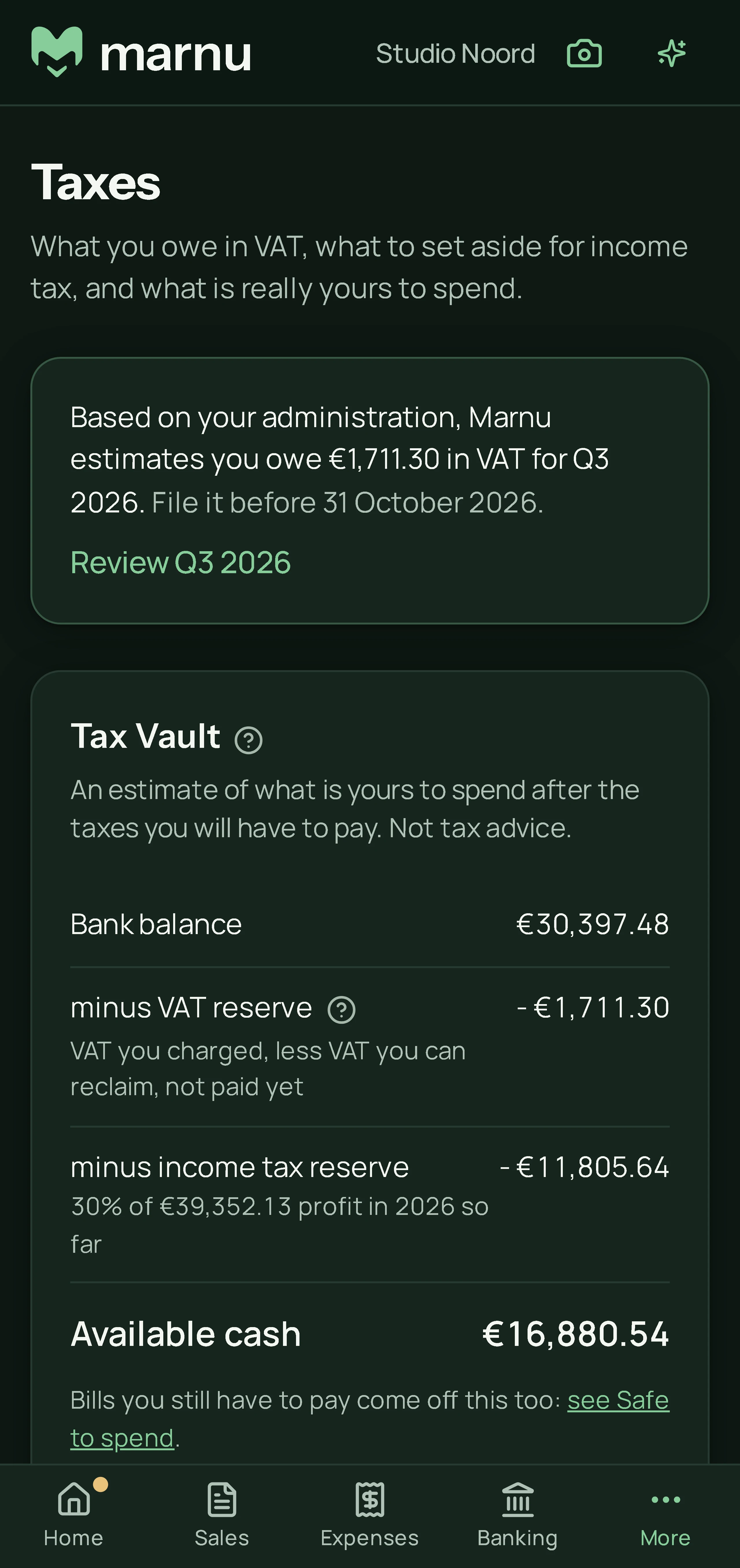
On top of the books sit the answers the owner actually asked for. Safe to spend takes the bank balance and subtracts the VAT that is not theirs, the income tax to set aside, the bills coming up and a buffer of their choosing. A forecast runs day by day from today’s balance, with expected invoices, bills and running agreements in it. And Ask Marnu answers questions in normal language: what renews next month, which customers pay late, why costs went up.
The web app is built with Next.js and TypeScript, and the data lives in PostgreSQL, through Supabase, in Frankfurt.
Decisions that shaped it
Every figure comes from the ledger
One rule decides most questions. Every number Marnu shows comes from the ledger, or from a source table, through a plain function that gives the same answer every time. A friendly page is a view of the books, never a second copy of them.
That rule turns down tempting shortcuts. The EU sales list, for one, must by law agree with the VAT return. Storing it would create a second copy that could drift, so Marnu computes it from the issued invoices every time and compares the two. When they differ, the difference points at a real cause, such as an EU sale booked on a bank line without an invoice.
The books defend themselves
Every journal entry is written by one function, and the database checks it again when it is committed: it must balance, a posted entry can never be changed, and nothing may land in a period that is closed. A mistake is corrected by a new entry, never by editing an old one.
Money is never a floating-point number. Amounts are whole cents, and a check in the build refuses any code that computes a total with a float. Depreciation is booked month by month, and a month that is closed is never touched again: change an asset’s useful life and only the months still open take the difference.
A correction is a new entry
A posted entry is history. Marnu never rewrites one: it books a correction beside it, dated in the first open period. The books always show what happened, and when.
AI explains, it never computes
Ask Marnu understands a question, picks the verified function that answers it, and runs it. The language model only receives the result and puts it into words. The figures on screen come from the function, not from the model, so a model that gets creative cannot invent a total. AI is optional: the owner brings their own key, which is stored encrypted.
Automation follows the same line. Matching a bank line, spotting a subscription, noticing a possible duplicate: each becomes a proposal, with a reason and a confidence, and the owner decides. Marnu books on its own only where the owner made the rule or the match is exact.
Offer, don’t fill in
Upload a contract and Marnu reads its start date, renewal, notice period and amount, with fixed rules rather than AI. It does not fill those into the form. Each value sits beside its field with the words it was read from, and goes in only when the owner chooses it. A filled-in form would make a misread date look like the owner’s own.
Honest about what it cannot know
An agreement holds a price without VAT; a bank line holds one with VAT, at a rate the bank does not say. Comparing them directly would flag every contract. So Marnu calls a payment too high only when it is above the agreed price plus the highest Dutch rate of 21%. We wrote down the cost of that choice too: a supplier that charges no VAT could raise its price by 21% before Marnu notices.
The same honesty runs through the rest. When the EU’s VAT number service does not answer, Marnu records “no answer”, never “invalid”. A completeness score rounds down, so one missing receipt in a thousand shows 99%, not 100%.
Proven by the official rules
Marnu exports invoices in the European e-invoicing standard. Rewriting the standard’s rules ourselves would only prove that we agree with ourselves, so the export is checked against the official, published rules, pinned so they cannot change underneath us. All ten sample invoices pass, and two invoices we broke on purpose were refused.
Isolation in the database, not the screens
Every query runs as the signed-in person, under the database’s own row-level security. The app’s own database role can read nothing, and the browser never talks to the database or to an AI provider directly. A forgotten filter in a new screen cannot show one business another’s books.
How it runs
- Nothing reaches production until a person promotes it, and only after every check has passed on that exact commit, the rule we first set for the E-Bike Battery Passport.
- The app and its database run in Frankfurt, and its email goes out from Paris.
- Erasing a customer’s data runs over a separate administrative connection that the live app does not have, so a stolen session cannot erase anything.
- Unit tests prove the bookkeeping rules without a database; database tests prove the isolation and the journal’s rules with one; browser tests walk the main flows.
Where it stands
Marnu has kept our own books since 2 October 2026, at marnu.silentpixel.net, invite-only. Its specification has more than 160 entries built. Among the few still open is more bookkeeping for partnerships: profit shares per partner, and an energy investment allowance.
A pilot with Dutch business owners is taking sign-ups.
What we take from it
Accounting software is judged on one thing: whether its numbers are right. Most of the work in Marnu is invisible: a database that refuses an unbalanced entry, a check that refuses a float, a model that is never trusted with a sum, a form that offers rather than assumes. The plain language on top is only worth something because of what sits underneath.
That is the care we bring to software we build for anyone else.